
From Cotton to Contraband — A 175-Year History of Smuggling on the Rio Grande
 c1850s~ moonlit illustration of smugglers of cotton crossing the Rio Grande (some men hiding in the high grass). They look like "mules" carrying all that weight on their backs.
Introduction — The River That Never Changed
Along the Rio Grande, commerce has never been entirely one thing or another.
It has never been fully legal, nor entirely illicit.
It has never belonged to one nation alone.
From the earliest days of Brownsville and Matamoros, the river functioned as something more fluid—a corridor where goods, people, and opportunity moved according to geography as much as law.
The commodities changed over time.
The methods evolved.
The scale expanded.
But the system itself—the quiet negotiation between profit, enforcement, and distance—remained remarkably consistent.
What follows is not a story of crime alone, but of continuity.
🧭 I. The Frontier Trade — Cotton, Rifles, and Opportunity (1840s–1860s)
In the 1850s, merchants like Charles Stillman operated in a world where legality was often situational.
Cotton moved downriver in bales—sometimes American, sometimes Mexican, often indistinguishable once compressed and shipped. Duties could be negotiated, avoided, or simply worked around depending on circumstances.

Rifles and ammunition followed similar paths. When official channels became restrictive, alternate routes emerged. Trade did not stop—it adapted.
The Charles Stillman letters of this period preserved today in documents like 1850 0901 Charles Stillman → Joseph Morell reveal a system built not on rigid compliance, but on flexibility:
cargo redirected across the river
goods re-routed into Mexico to avoid duties
vessels and intermediaries used strategically
This was not chaos. It was a functioning economy—one that understood the river better than the law did.

🚢 II. Steam, Sandbars, and the Height of River Commerce (1870s–1910s)

By the late 19th century, the river itself became the central artery of trade.
Flat-bottomed steamboats carried goods upriver—cotton, hides, manufactured goods—linking Brownsville to inland markets such as Rio Grande City and beyond.
Yet even at its height, the system retained its improvisational nature:
shifting sandbars dictated routes
cargo transferred between vessels offshore
timing mattered as much as ownership
The same flexibility that defined the 1850s persisted, only now supported by steam power and expanding infrastructure.

But the river was already beginning to change.
Silt accumulated. Navigation became unreliable.
By the early 20th century, the steamboat era was fading—closing one chapter, but not the system itself.
🍾 III. Prohibition — The River Goes Underground (1920s–1933)


When the United States outlawed alcohol in 1920, the Rio Grande found a new purpose.
Liquor flowed north.
Money flowed south.
Small boats, hidden crossings, and familiar routes—many of them inherited from earlier trade patterns—enabled a steady movement of contraband.
Unlike the frontier era, this was explicitly illegal. But the mechanics were familiar:
exploiting jurisdictional differences
using geography as advantage
relying on local knowledge
Prohibition did not create smuggling on the Rio Grande.
It simply made it visible.

Sidebar ~ Philip Leonard wrote on the Brownsville, Texas & RGV
History FB page:
Tequileros were smugglers who transported alcohol from
Mexico into the United States during Prohibition (1920–1933). They typically
operated through back trails & low-water crossings along the Rio Grande,
often through the backstreets of Brownsville. A skilled packer could fit fifty
or more protectively-wrapped bottles on a mature mule or donkey. Layers of hay
or grass helped prevent bottles from breaking and muffled the clanking of
glass.
Tequileros were ultimately driven out of business before the end of Prohibition by Texas Rangers & U.S Customs, with whom contact often ended violently. Over the next century, the routes, networks, & political connections created by tequileros, particularly those of Juan Nepomuceno Guerra featured in Netflix’s “Narcos” would ultimately transform into the modern-day drug cartels. Instead of Tequila, they bring bags of Cocaine, Dilaudid, Meth and other kinds of death to the valley and other parts of the USA. They come by horseback and unload into 18 wheelers in barns on this side of the border.


🚬💊 IV. The Quiet Years — Cigarettes, Cars, and Early Narcotics (1930s–1960s)
After Prohibition ended, the headlines faded—but the activity did not.
This was a quieter era, but an important one.
Across the river moved:
cigarettes and taxed goods, exploiting price differences
automobiles and parts, stolen or redirected
marijuana and early narcotics, still small-scale but growing
people, guided across the river in response to labor demand
There were no large cartels yet. No international headlines.
But the routes were being established.
The networks were forming.
What had once carried cotton and hides now carried new commodities—less visible, but increasingly consequential.
💰 V. The Cartel Era — Scale and Structure (1970s–2000s)


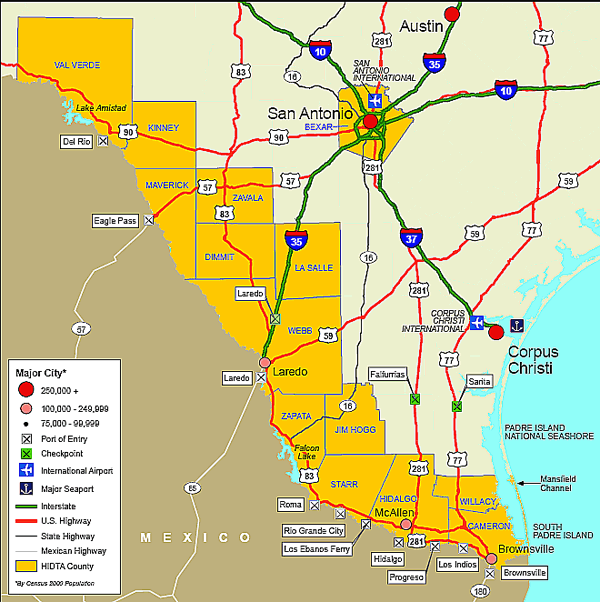

By the 1970s, the system reached a new level of organization.
Marijuana gave way to cocaine.
Small networks gave way to structured organizations.
What had once been opportunistic became industrial:
coordinated transport routes
concealed compartments
layered distribution systems
The Rio Grande remained central—not always as the crossing itself, but as part of a broader corridor shaped by the same geography that had guided trade for over a century.
⚠️ VI. The Synthetic Age — Precision and Risk (2000s–Present)

Today, the commodities have changed again.
Fentanyl and synthetic drugs require:
smaller volumes
higher potency
more precise concealment
The scale is different, but the logic is not.
The same forces remain:
demand across the border
differences in regulation and enforcement
the enduring influence of geography
⚠️ VII. Human Smuggling and Exploitation — The Most Consequential Trade (Late 20th Century–Present)

Alongside the movement of goods, the Rio Grande has also long been a route for the movement of people.
By the mid-20th century, informal crossings—often guided by individuals later known as coyotes—became a regular part of life along the border. For many, this movement was tied to labor demand, family reunification, and economic necessity. It was visible, sometimes tolerated, and often woven into the everyday rhythm of border communities.
In recent decades, however, this system has changed.
What was once largely small-scale and locally organized has, in many areas, been absorbed into broader criminal networks. Human smuggling has become more structured, more expensive, and more dangerous. Migrants are now frequently subject to:
extortion and coercion during transit
abandonment in dangerous terrain or conditions
forced labor or debt bondage

Most troubling is the documented growth of human trafficking, particularly affecting vulnerable populations, including women and minors. Unlike smuggling—which involves consent to be transported—trafficking involves exploitation, coercion, or force, and represents one of the most serious humanitarian concerns along the modern border.
Reports from various regions of the border, including cities such as Reynosa, have at times described patterns of violence, abduction, or exploitation connected to organized criminal groups. Conditions can change quickly, and experiences vary widely, but the risks faced by vulnerable individuals—especially those traveling alone—are real and well documented by humanitarian organizations and law enforcement.
For communities along the Rio Grande, this marks a profound shift. The river that once carried goods—and later contraband—now also reflects the movement of people under conditions that are often far more precarious.
🧠 Conclusion — What the River Carried
For 175 years, the Rio Grande has carried more than water.
It has carried cotton, rifles, whiskey, cigarettes, automobiles, marijuana, cocaine, and now synthetic drugs.
Each era believed itself to be unique.
Each introduced new goods, new methods, new risks.
And yet, the underlying system persisted.
The river did not create smuggling.
It enabled movement.
And wherever movement met profit—and law struggled to keep pace—the same pattern emerged.

The commodities changed—cotton, rifles, whiskey, cigarettes, automobiles, narcotics—but the system did not. The river remained what it had always been: a corridor where law, profit, and geography negotiated their own uneasy balance.

No comments:
Post a Comment