
Where the River Meets the Ledger
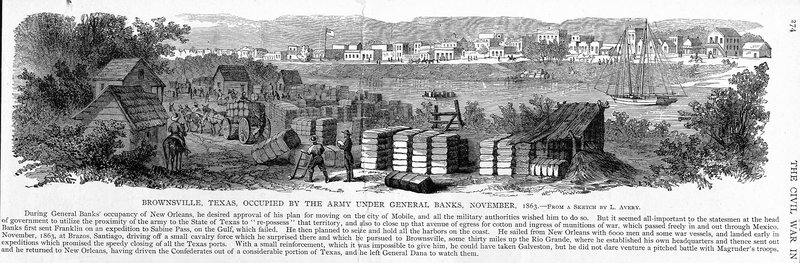
By the summer of 1851, the rhythm inside Charles Stillman’s warehouse had changed.
Six months earlier, the work had centered on stability — settling accounts, extending measured credit, keeping cotton moving downriver toward the Gulf. But by July the tempo quickened. The ledgers grew denser. The ink strokes lengthened. Transactions multiplied in both direction and complexity. What had begun as a frontier mercantile operation was steadily evolving into something more intricate — a financial organism tied to two nations and three economies at once.
The Rio Grande did not slow in summer. Neither did Stillman.
I. Cotton as Currency
By mid-1851, cotton was no longer simply a commodity passing through Brownsville — it had become the bloodstream of Stillman’s expanding enterprise.
Planters on both sides of the river consigned bales to him. Some paid old debts. Others borrowed against future harvests. A few operated entirely on credit, their crop already pledged before it was picked. Cotton in this system functioned as:
Collateral
Medium of exchange
Proof of solvency
Speculative instrument
Stillman was not merely shipping cotton; he was structuring obligations around it.
Each bale tied a planter to him. Each advance strengthened his hold over the regional trade network. By late 1851, his books show not just buying and selling, but the management of future risk — a clear marker of a maturing commercial mind.
II. Credit: The Quiet Engine
Credit in 1851 South Texas was both lubricant and liability.
The region lacked stable banking infrastructure. Hard currency was scarce. Mexican silver circulated alongside American coin, and paper instruments traveled slowly. In this environment, reputation functioned as capital.
Stillman’s growing success depended on three interlocking forms of credit:
Local credit extended to ranchers and planters
Transnational arrangements with suppliers and shipping contacts
Personal trust relationships cultivated face-to-face
His ledgers reveal widening circles of obligation. Names reappear across pages — some reliable, some increasingly precarious.
The deeper the credit web, the greater the exposure.
And by late 1851, that web had expanded significantly.
III. The Warehouse as Nerve Center
The warehouse facing the Rio Grande was no longer just storage space. It had become:
A counting house
A clearing station
A negotiation chamber
A place where languages overlapped — English and Spanish interwoven across invoices
Invoices for textiles. Orders for hardware. Shipments of tools, dry goods, and clothing. References to velveteens (a durable cotton fabric with a velvet-like finish, popular for working garments) and English imperials (a type of heavy glazed cloth used for structured garments or durable outerwear) remind us that this was not a primitive outpost. Brownsville was tied directly to Atlantic trade routes.
And inside that warehouse, Stillman coordinated it all.
Not flamboyantly. Not loudly.
Methodically.
IV. Mexico, Instability, and Opportunity
The border in 1851 was not merely a line on a map. It was a shifting political and economic condition.
Instability in northern Mexico often disrupted supply chains — but it also created opportunity. Traders who could navigate customs procedures, fluctuating tariffs, and sudden policy shifts stood to profit. Those who misjudged timing could lose everything.
Stillman appears increasingly adept at balancing this tension.
His records show growing cross-river engagement. More Mexican correspondents. More cross-border movements of goods and funds. More exposure — but also more reach.
He was no longer simply a Brownsville merchant. He was positioning himself as a binational commercial intermediary.
V. The Growth Pattern: What Changed in 1851?
Looking at the year as a whole, a pattern emerges.
January–June 1851
Stabilization. Consolidation. Measured expansion.
July–December 1851
Acceleration. Broader credit exposure. Increased volume. Structural growth.
The difference is subtle but significant.
Stillman’s operation in late 1851 reflects confidence. He is extending further. Buying more. Advancing more. Trusting more capital to the river’s uncertain currents.
This is the moment when a frontier merchant begins transforming into a regional power.
VI. Risk Beneath the Ink
But expansion always carries tension.
By December 1851, several realities loom:
Cotton prices fluctuate unpredictably.
Political stability across the border cannot be guaranteed.
Credit chains lengthen beyond immediate personal oversight.
The larger the operation, the more dependent it becomes on distant events.
Yet nothing in the surviving records suggests hesitation.
Stillman seems to understand that scale is the path forward.
The Rio Grande was not a quiet river. It rewarded those willing to move with it.
VII. A Closing Scene: Winter 1851
Picture the warehouse in December.
A chill wind slips through the door when it opens. The river runs low but steady. Somewhere outside, cotton bales wait for shipment. A wagon creaks to a halt in the yard.
Inside, lamplight falls across open ledgers. Columns of figures stretch across the page — not just records of goods, but architecture. A design in ink. A system taking shape.
By year’s end, Charles Stillman’s business is no longer fragile. It is layered.
Goods
Credit
Reputation
Cross-border leverage
He has built not just a store, but a financial framework capable of growth.
The true expansion of Brownsville’s commercial identity is underway.
And the river keeps moving.

No comments:
Post a Comment