
Where the River Meets the Ledger
January–June 1852: Freight, Firelight, and the Weight of Credit
In the first days of January 1852, the wind off the Rio Grande carried the smell of damp wood, mule sweat, and river mud into the warehouse doors of Charles Stillman. The holiday quiet had passed. Account books reopened. Bills came due.
Across the water lay Matamoros. Behind him, the sandy streets of Brownsville. Between the two—like a hinge on which everything turned—stood his ledger.
By 1852, Stillman was no longer merely surviving on the frontier; he was structuring it. The entries from January through June show not drama but discipline: invoices, freight charges, insurance calculations, drafts drawn on distant houses, cotton received, goods advanced, balances carried forward. Yet beneath those lines of ink lay something larger—the shaping of a commercial system along a restless border.
Credit Before Cotton
The year opens with credit extended before crops were even ginned. Advances went out to planters and intermediaries who would not deliver cotton for months. Cloth, tools, provisions, hardware—all moved outward from the warehouse on faith and reputation.
Frontier commerce rarely worked on cash. It worked on expectation.
A planter might receive goods in January against cotton to be delivered in March or April. A teamster might be advanced funds for freight. A river captain might be paid in part before departure. Each transaction tied the future to the present.
Stillman’s genius was not bold speculation—it was calibration. He extended credit broadly but tracked it relentlessly. The ledger reveals a man who understood that liquidity on the Rio Grande depended less on coin than on confidence.
The River as Artery
By spring, cotton began to move.
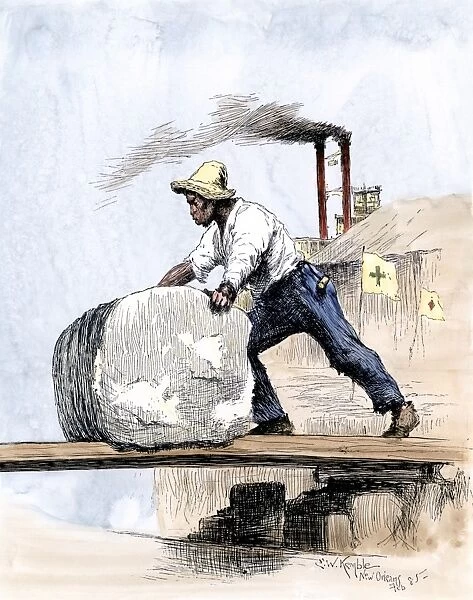
Bales arrived by wagon, creaking through sandy streets before sunrise to avoid heat. They were weighed, tagged, stacked. From there, they would move downriver by lighter craft or await transfer to steamers bound for the Gulf.
River transport was never certain. Sandbars shifted. Water levels fell without warning. Delays meant exposure—both financial and physical. Cotton sitting too long risked damage. Capital sitting too long risked stagnation.
The entries show freight charges, insurance notations, commissions, and correspondence tied to shipments outward. Cotton did not merely depart; it triggered a cascade of accounting: drafts drawn against expected sale proceeds in New Orleans or beyond, credits applied to prior advances, balances recalculated.
The warehouse facing the river was both storage house and financial engine.
Goods Flowing In
While cotton flowed outward, manufactured goods flowed inward.
Velveteens—durable cotton pile fabric popular for workwear—appear again in shipments. English imperials—fine printed cotton textiles—were among the finished cloths desired for dress. Hardware, iron, agricultural tools, barrels of staples, perhaps even luxury items for those newly flush from a good crop year—all found their way into inventory.
These goods did not simply sit on shelves. They were distributed across a widening hinterland. Each bolt of cloth or crate of hardware extended the commercial reach of the warehouse deeper into ranch country and river settlements.
The ledger from these months shows the frontier not as isolation, but as circulation.
Risk and Reputation
By mid-1852, patterns emerge.
Some accounts are steady—paid down as promised. Others stretch longer, balances rolling forward. A merchant in this environment required more than arithmetic; he required judgment of character.
Who could be trusted another season?
Whose word was collateral enough?
Where did firmness need to replace patience?
There is little overt commentary in the papers. But the rhythm of entries—partial payments, renewed drafts, recalculated totals—reveals a quiet management of risk.
Stillman’s position was delicate. Too rigid, and trade would constrict. Too lenient, and capital would evaporate. His success rested in walking that line with consistency.
Border Realities
The first half of 1852 was not marked by headline conflict, yet the border remained inherently unstable. Political shifts across the river, fluctuations in currency, and the ever-present uncertainty of transport shaped daily calculations.
Exchange rates mattered. So did trust across languages and jurisdictions.
Each draft drawn, each shipment consigned, carried not only economic weight but geopolitical awareness. The Rio Grande was a boundary on maps; in practice, it was a commercial corridor.
Stillman operated in that corridor with the instincts of a banker as much as a trader.
The Warehouse at Dusk
Imagine the scene in June.
The heat heavy. Mosquitoes rising from the riverbank. The last wagon creaking away. Inside, a candle lit against the gathering dark.
At a desk—perhaps a slanted Davenport—the merchant reviews columns:
Freight. Commission. Insurance. Advances. Returns.
No flourish. No wasted ink.
Outside, the river keeps moving.
Inside, the ledger captures its motion in figures.
January through June 1852 shows no spectacular gamble, no dramatic collapse—only the steady tightening of a commercial web across South Texas and northern Mexico. Cotton, cloth, credit, freight, insurance: each strand reinforcing the others.
The frontier did not become stable overnight. It became stable line by line.
And in those months, the balance held.

No comments:
Post a Comment